Most people exercise because they want to look better, lose weight, or build muscle.
Those are great goals. But there's another reason to train that becomes increasingly important as you get older: maintaining the physical ability to enjoy your life.
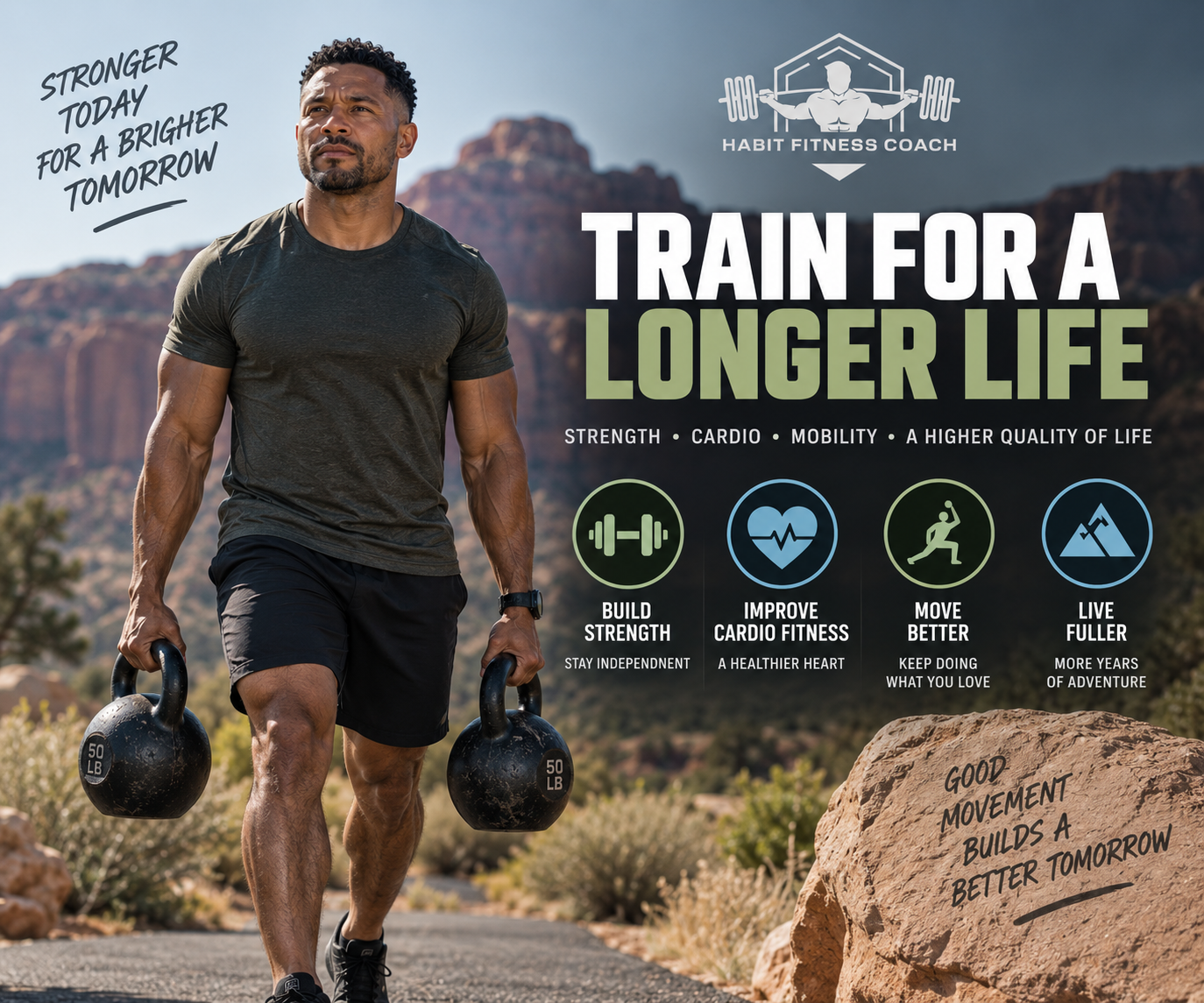
The best exercises for longevity aren't about finding one magical movement. A smart longevity workout should help you maintain strength, cardiovascular fitness, mobility, balance, and the ability to move confidently for decades.
As a personal trainer in St. George, Utah, that's ultimately what I want fitness to accomplish: not simply adding years to your life, but helping you do more with those years.
Strength Training for Longevity: Build Muscle You Can Keep
Strength training should be one of the foundations of a longevity-focused exercise program.
Muscle isn't just for appearance. Strength helps you climb stairs, carry groceries, pick up your kids or grandkids, maintain independence, and continue doing the activities you enjoy as you age.
Your training doesn't need to be complicated.
Build your program around fundamental movements like:
Squats and split squats
Deadlifts and other hip hinges
Push-ups and presses
Rows and pulldowns
Loaded carries
Two to four resistance-training sessions each week can build a strong foundation.
Don't train simply to become tired. Train to gradually become stronger.
VO2 Max: Don't Forget to Train Your Heart
If strength represents one side of longevity, cardiovascular fitness represents another.
VO2 max is a measurement of your body's ability to use oxygen during intense exercise. You don't need to be an endurance athlete to care about it.
Higher cardiorespiratory fitness has consistently been associated with better long-term health outcomes.
How Do You Improve It?
Combine easier cardiovascular exercise with occasional higher-intensity work.
Walking, hiking, cycling, rowing, swimming, and jogging can all help build your aerobic base. Then, depending on your health and current fitness level, short intervals can challenge your cardiovascular system at higher intensities.
You don't have to choose between strength and cardio.
For healthy aging, train both.
Mobility for Longevity: Maintain the Ability to Move
Living longer isn't particularly exciting if your body can't comfortably do the things you love.
That's why mobility for longevity matters.
Mobility is your ability to actively control your joints through useful ranges of motion. Good mobility can help you squat down, reach overhead, rotate, get off the floor, and move confidently.
Rather than spending 30 minutes stretching every day, identify the areas where you're actually limited.
For many adults, consistently working on ankle, hip, upper-back, and shoulder mobility for even five or ten minutes can be useful.
The Best Longevity Workout Combines Multiple Qualities
There's no single "best" longevity exercise.
Instead, think of your fitness like an investment portfolio.
You don't want everything invested in one place.
A well-rounded week might include three strength workouts, two cardiovascular sessions, regular walking, and short mobility work throughout the week.
You should also continue doing activities you genuinely enjoy.
Hike.
Bike.
Golf.
Play basketball.
Run around with your kids.
Your body was built to move, and exercise shouldn't exist exclusively inside a gym.
Healthy Aging Starts Earlier Than You Think
Don't wait until you're 65 to start thinking about healthy aging.
What you're capable of later in life is influenced by what you build and maintain now.
If you're 35, 40, or 50, your training isn't just preparing your body for next summer.
You're building physical reserves for the next several decades.
Get strong enough that losing some strength with age still leaves you strong.
Build cardiovascular fitness so everyday activities remain easy.
Maintain enough mobility that you can continue moving freely.
And build habits you can realistically maintain.
The best exercises for longevity aren't necessarily the newest, hardest, or most complicated.
They're the exercises that build a capable body—and that you continue doing year after year.
Want help turning these principles into a program that fits your body, goals, injuries, and schedule? Get personalized coaching through Habit Fitness Coach and learn how to put strength, cardiovascular fitness, mobility, and healthy aging into action.