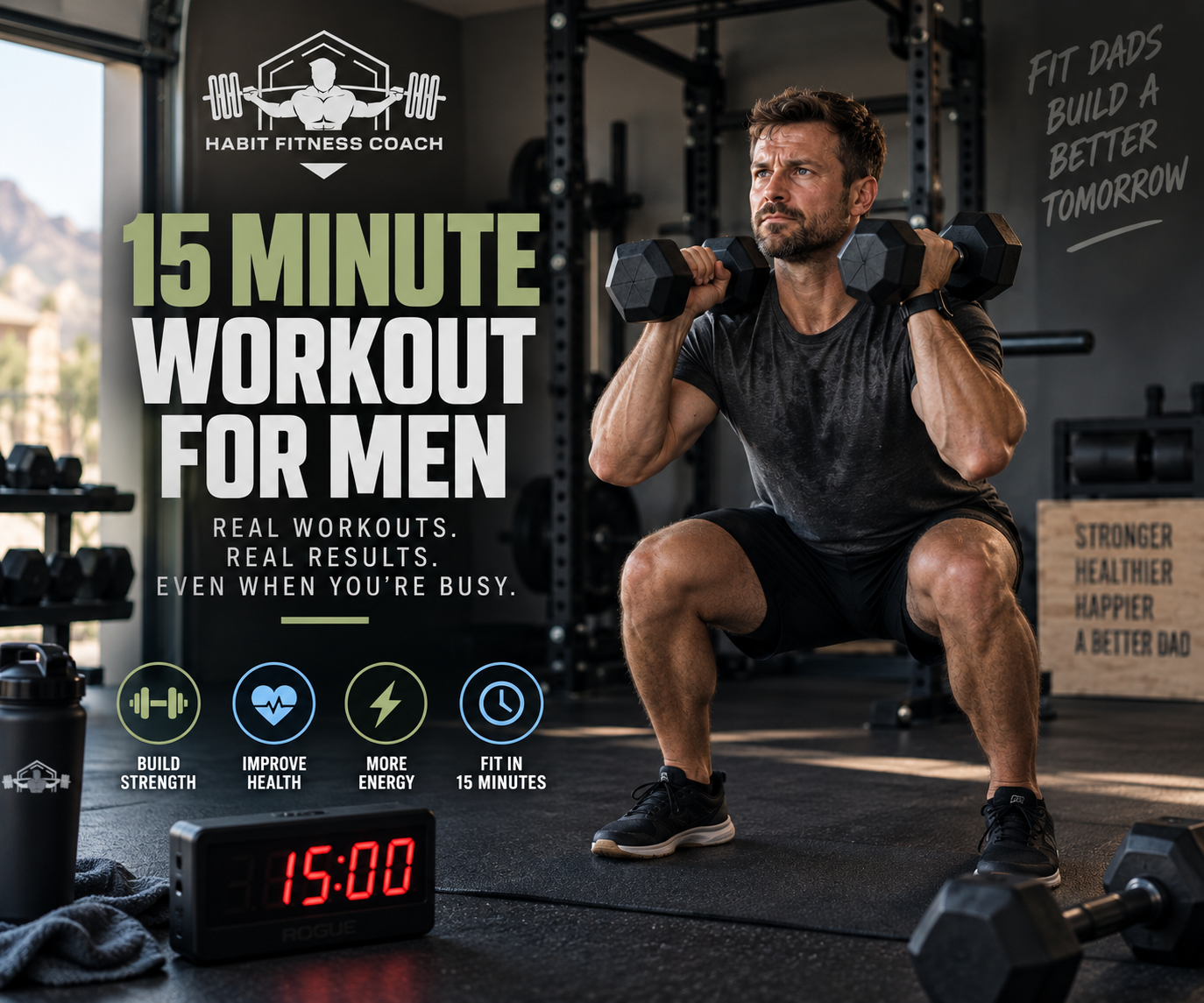
“I don't have time to work out.”
As a personal trainer, this is one of the most common reasons I hear from busy men who have stopped exercising. And I get it. Between work, kids, relationships, errands, and everything else competing for your attention, finding an uninterrupted hour to exercise can feel impossible.
But what if you didn't need an hour?
A well-designed 15 minute workout for men can accomplish far more than most people realize. If you're willing to train with purpose, 15 minutes a day can be enough to build strength, improve cardiovascular fitness, and establish a fitness routine you can actually maintain.
The secret isn't cramming a 60-minute workout into 15 minutes. It's choosing the exercises that give you the greatest return for your time.
Can a Quick Workout for Men Actually Work?
More exercise isn't automatically better if you can't consistently do it.
Research on time-efficient resistance training suggests that relatively small amounts of training can improve strength. Instead of assuming a workout has to be long to be worthwhile, researchers have increasingly studied the “minimum dose” of exercise required to create meaningful improvements.
That changes the conversation.
If you only have 15 minutes, don't spend those 15 minutes worrying that your workout isn't long enough.
Use them.
Research on time-efficient resistance training has emphasized prioritizing multi-joint movements that train large amounts of muscle simultaneously. That means exercises like squats, presses, rows, and deadlift variations give you significantly more return on your time than performing six different isolation exercises.
The Busy Dad Workout: Five Days, 15 Minutes
If I were programming for a busy dad with only 15 minutes available each day, I wouldn't try to make every workout identical.
I'd divide the week between strength and cardiovascular conditioning.
A simple schedule might look like this:
Monday: Full-body strength
Tuesday: HIIT/cardio
Wednesday: Full-body strength
Thursday: HIIT/cardio
Friday: Full-body strength
Saturday: Walk, hike, play with your kids, or recover
Sunday: Rest or light activity
That's only 75 minutes of structured exercise across the entire workweek.
And because the sessions are short, there's less friction involved in getting started.
Your 15-Minute Short Strength Workout
For your three strength days, simplicity wins.
You don't need eight exercises.
You need a few movements performed well and consistently.
Workout A
Set a timer for 15 minutes.
Perform:
Squat: 6–10 reps
Push-up or dumbbell press: 8–12 reps
Dumbbell or cable row: 8–12 reps
Move between the exercises efficiently while still giving yourself enough recovery to maintain good technique.
Workout B
For your next strength session:
Romanian deadlift: 6–10 reps
Overhead press: 8–12 reps
Lat pulldown or assisted pull-up: 8–12 reps
Alternate between these two workouts throughout the week.
The goal isn't to perform as many sloppy repetitions as possible before the timer ends. The goal is to accumulate quality work.
When an exercise becomes easy, gradually increase the resistance or repetitions.
That's progressive overload—and it's one of the fundamental principles behind getting stronger.
HIIT for Men Who Don't Have Time for Cardio
The other two days can focus on your cardiovascular system.
High-intensity interval training, or HIIT, alternates harder bursts of activity with periods of easier recovery.
Short-duration interval training has attracted considerable research attention because meaningful cardiovascular and metabolic adaptations may be possible with surprisingly small time commitments.
One approach researchers have investigated uses only a few very short, hard efforts within an approximately 10-minute session.
That doesn't mean every man should immediately start performing all-out sprints.
Intensity should match your current fitness level.
A Simple 15-Minute Cardio Session
Start with a few minutes of easy movement.
Then alternate approximately 30 seconds of harder work with 60–90 seconds of easier recovery.
You could use:
A stationary bike, rowing machine, incline treadmill, hill, sled, or another form of conditioning that allows you to safely increase intensity.
If you're new to exercise, your “hard” interval doesn't need to be an all-out sprint. Start conservatively and build your conditioning over time.
Why 15 Minutes Can Beat the Perfect One-Hour Program
The biggest advantage of short workouts isn't physiological.
It's behavioral.
Finding 15 minutes is much easier than finding 60.
You can train before your kids wake up, during lunch, immediately after work, or while dinner is cooking.
This removes one of the biggest barriers to fitness: getting started.
A perfect workout you perform twice per month isn't very useful.
A good workout you perform consistently can change your health.
Don't Confuse “Enough” With “Optimal”
There's an important distinction here.
If your goal is maximizing muscle growth, becoming an elite athlete, or reaching your absolute strength potential, you're probably going to need more than 15 minutes per day.
But that's not everyone's goal.
Maybe you want to lose some body fat.
Maybe you want more energy.
Maybe you want to feel athletic again, keep up with your kids, get stronger, and improve your long-term health.
For those goals, short workouts can be incredibly valuable.
And there's another benefit: 15 minutes doesn't have to remain 15 minutes forever.
It can simply be your starting point.
Make Your 15 Minute Workout for Men Automatic
Here's the practical takeaway I give busy clients:
Choose a specific 15-minute window and protect it.
Don't wait until you “have time.”
Put it on your calendar.
Three days per week, lift. Two days per week, challenge your cardiovascular system. Outside those workouts, walk and stay physically active whenever possible.
Do that consistently before worrying about complicated programming, supplements, fitness trackers, or the latest workout trend.
Fitness doesn't need to dominate your life to improve it.
Sometimes the best program isn't the one that asks you to do more.
It's the one you can actually keep doing.
Want to start training at home without wasting time figuring everything out yourself? Check out my free resources for simple workouts and fitness tools you can start using today through Habit Fitness Coach.