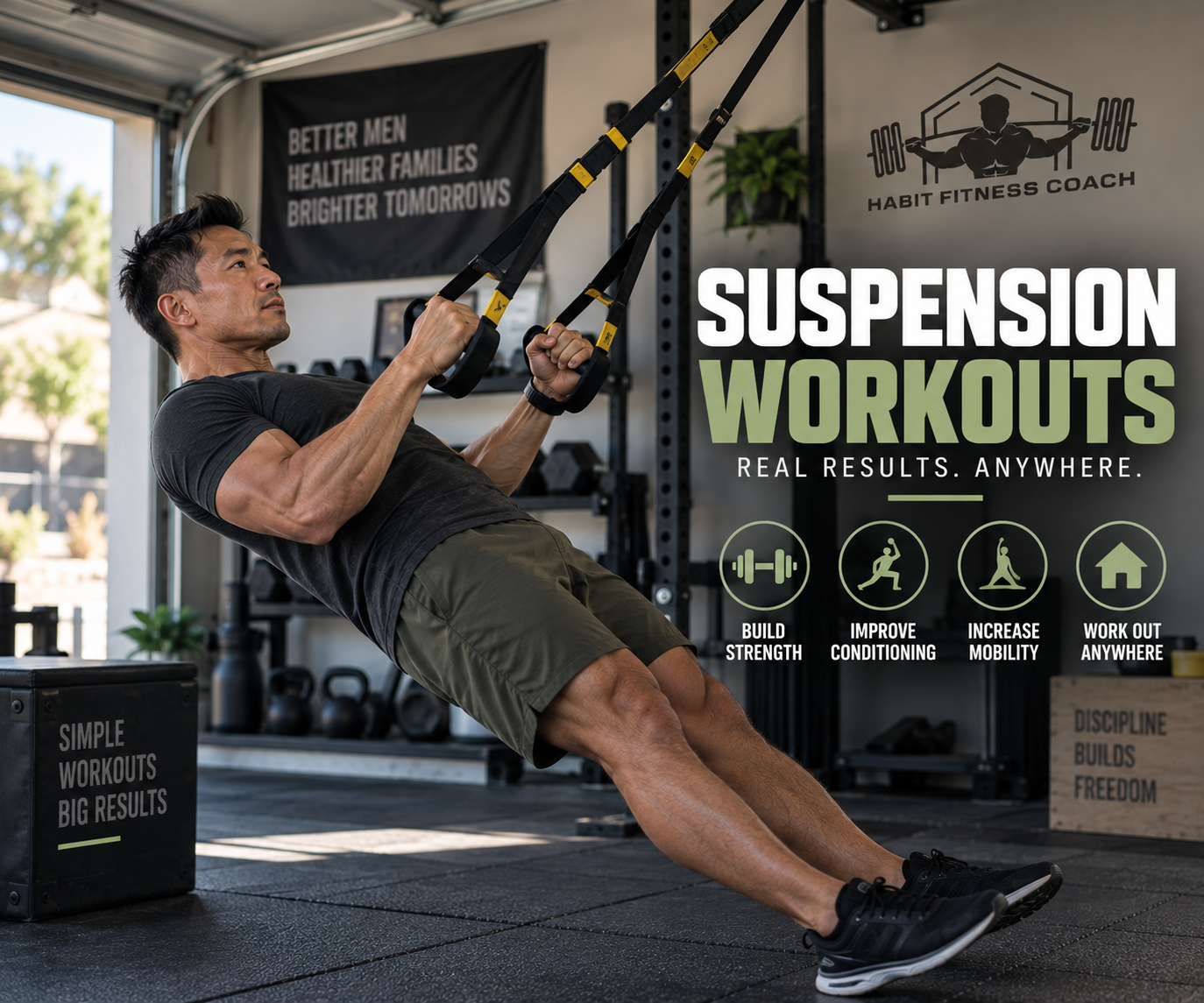
You don't need a garage full of equipment to build a stronger body.
A suspension trainer, a secure anchor point, and a few feet of space can give you dozens of ways to train your chest, back, legs, shoulders, arms, and core.
That's what makes a suspension trainer workout one of my favorite options for people who want to exercise at home. It's portable, scalable, relatively inexpensive, and surprisingly challenging when used correctly.
Research has also found suspension-based resistance training can improve measures of strength, muscular endurance, balance, and functional fitness.
Why Suspension Training Exercises Work
Suspension trainers use your body weight as resistance.
The major advantage is how easily that resistance can be adjusted.
During a suspension row, for example, standing more upright makes the movement easier. Move your feet forward and lean farther back, and suddenly you're pulling significantly more of your body weight.
That makes suspension training exercises easy to scale to your current fitness level.
The straps also introduce an element of instability. Your body has to control your position throughout each movement, which can increase the demand placed on your core and stabilizing muscles.
A Home Workout for Men Doesn't Need Much Equipment
One reason people stop exercising at home is that they think they need a complete home gym.
You don't.
If you're a busy professional, dad, frequent traveler, or simply someone who doesn't enjoy commercial gyms, a suspension trainer can cover many of the fundamental movement patterns I use when programming workouts for clients.
You can push, pull, squat, lunge, hinge, rotate, and train your core using one piece of equipment.
That makes it an excellent tool for a simple home workout for men who value efficiency.
Try This Full Body Suspension Workout
If you're new to suspension training, start with movements you can control before progressing to more challenging variations.
Try this simple full-body session:
Suspension Squat — 10–15 reps
Keep tension on the straps while sitting your hips down and back.Suspension Row — 8–12 reps
Keep your body straight and pull your chest toward the handles.Suspension Chest Press — 8–12 reps
Lean forward and lower your chest between the handles before pressing yourself back.Reverse Lunge — 8–10 reps per leg
Use the straps for balance while controlling the movement.Suspension Hamstring Curl — 8–12 reps
Place your heels in the straps and pull them toward your body while keeping your hips elevated.Suspension Plank or Body Saw — 20–40 seconds
Keep your trunk controlled without allowing your lower back to collapse.
Complete two to four rounds depending on your fitness level and available time.
How to Progress a TRX-Style Workout
Here's where many home workouts go wrong.
People repeat the exact same exercises with the exact same difficulty for months.
Your body needs progressive overload—gradually increasing the challenge placed on your muscles—to keep adapting.
With a TRX-style workout, you can progress by changing your body angle, increasing range of motion, slowing the lowering portion of the exercise, adding repetitions, reducing assistance, or progressing toward single-arm and single-leg variations.
Use This Simple Rule
When you can comfortably perform the top end of your repetition range with excellent technique, make the exercise slightly harder.
You don't need to completely change your workout.
Progress the movement you already know.
Suspension Training Is Simple—But Technique Still Matters
Suspension training is accessible, but that doesn't mean every exercise is automatically safe or effective.
Anchor placement, body position, joint alignment, exercise selection, and progression all matter.
A poorly performed suspension exercise isn't inherently better than a poorly performed dumbbell exercise.
Start with movements you can control, use a secure anchor rated for the equipment, and gradually increase difficulty as your strength improves.
A suspension trainer workout can be an excellent way to build muscle, improve fitness, and stay consistent without needing an expensive gym setup.
Want to learn how to use suspension training properly and build a program around your goals, movement limitations, and fitness level? Work with Habit Fitness Coach for personalized coaching and learn how to turn simple equipment into an effective long-term training program.