“I need to stretch more.”
I hear some version of this constantly from people dealing with tight hips, stiff shoulders, limited movement, or simply feeling less mobile than they used to.
Stretching can absolutely help—but there's an important distinction most people miss.
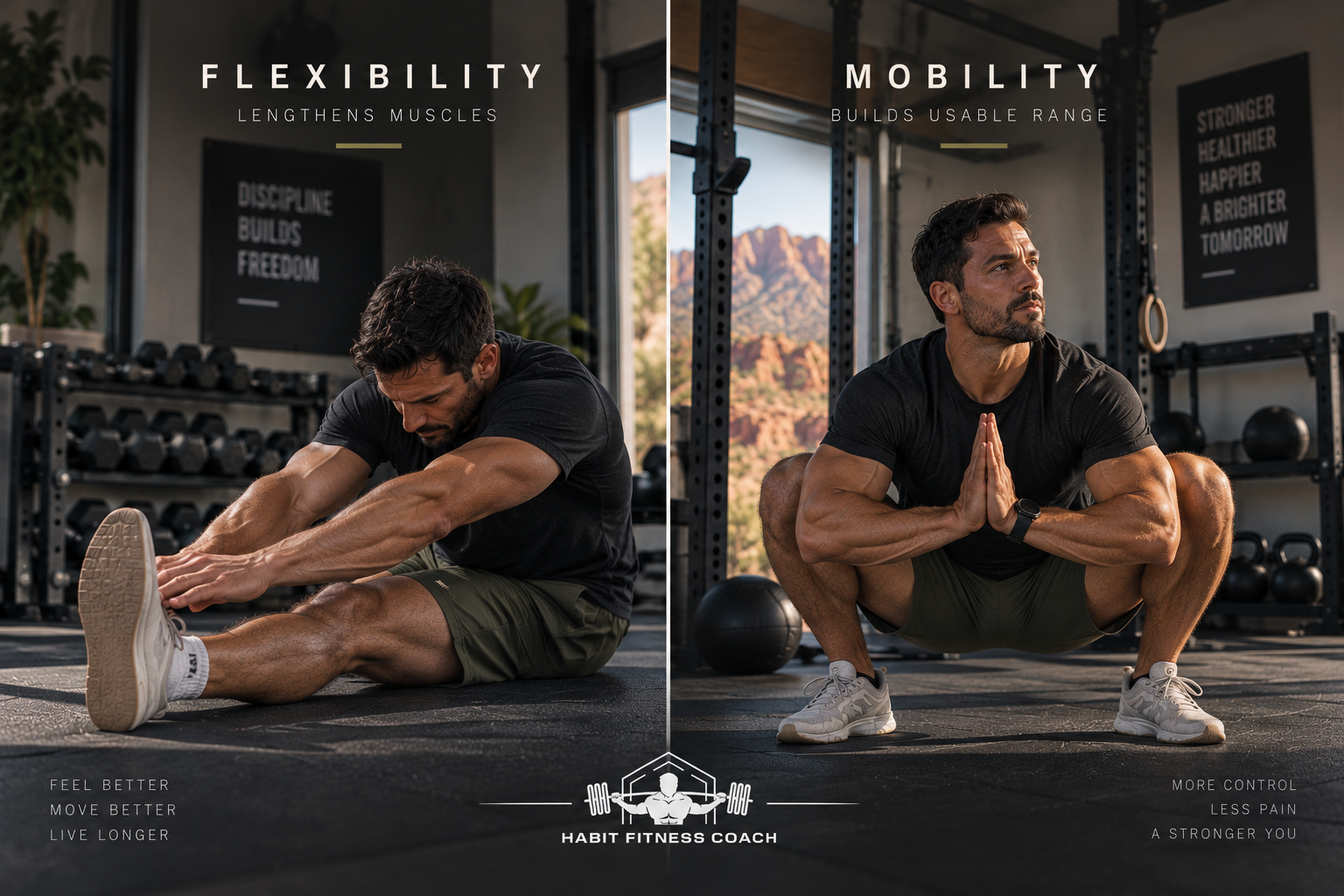
Flexibility and mobility aren't the same thing.
Understanding mobility vs flexibility can change the way you warm up, exercise, and take care of your body. Instead of endlessly stretching tight muscles, you can work toward something more useful: having enough range of motion and the strength to control it.
Mobility vs Flexibility: What's the Difference?
Flexibility generally refers to how far a muscle or joint can move through a range of motion.
Mobility includes your ability to actively control movement through that available range.
Think about someone lying on their back while another person pushes their leg toward their chest. They may have enough flexibility to reach a large range of motion.
Now ask that same person to actively lift and control their leg through that range.
That's mobility.
You don't just want your body to be capable of reaching a position. You want to be strong and controlled within the positions you use.
The Benefits of Stretching Go Beyond Feeling Loose
Stretching can be a useful way to improve range of motion.
Research supports both static stretching and other forms of flexibility training as effective ways to increase range of motion when performed consistently.
That can matter if restricted movement is preventing you from comfortably performing exercises or everyday activities.
But stretching isn't automatically the answer to every ache, pain, or movement restriction.
Sometimes what feels “tight” may be related to weakness, poor control, repetitive positions, or simply spending too much time sitting.
That's why an effective movement program should look beyond the sensation of tightness.
Mobility Exercises for Men Should Include Strength
If your goal is to improve mobility, don't think exclusively about stretching.
Strength training itself can improve range of motion, particularly when exercises are performed through appropriately large ranges.
A controlled deep squat, for example, isn't only strengthening your legs.
You're also practicing ankle, knee, and hip movement while producing force.
This is one reason I like combining mobility work with resistance training rather than treating them as completely separate categories.
Some useful mobility exercises for men include:
Deep squat holds or assisted squats
Split squats through a controlled range of motion
Hip 90/90 rotations
Controlled shoulder rotations
Thoracic spine rotations
Calf and ankle mobility drills
Full-range resistance exercises appropriate for your ability
The goal isn't forcing yourself into extreme positions.
It's gradually expanding the positions you can comfortably control.
Flexibility After 40: Why Movement Can Start Feeling Different
People often tell me they suddenly became stiff after turning 40.
Age can influence physical capacity, but lifestyle matters tremendously.
Think about how much you moved when you were younger.
You may have played sports, walked around school or college, spent more time outside, and regularly moved through different positions.
Then adult life happened.
You sit in a car.
Sit at work.
Sit during meetings.
Drive home.
Sit on the couch.
Over time, your body gets very good at the positions you repeatedly use.
Maintaining flexibility after 40 doesn't require becoming a yoga instructor. It means intentionally continuing to move your joints through useful ranges of motion.
When Should You Stretch?
Stretching doesn't need to become another complicated fitness routine.
Use it strategically.
Before strength training, I generally prefer dynamic movements that prepare you for the exercises you're about to perform.
If you're squatting, warm up your ankles, hips, and squat pattern.
If you're pressing overhead, prepare your shoulders and upper back.
Longer static stretches can be used separately or after training when improving flexibility is the specific goal.
Try the Five-Minute Rule
Here's something you can start today.
Pick the two areas where you feel most restricted and spend five minutes per day working on them.
Maybe that's your hips and ankles.
Choose one or two movements for each area, perform them consistently, and track whether your range of motion actually improves.
Five focused minutes every day is far more useful than randomly stretching for 45 minutes once every three weeks.
More Flexibility Isn't Always Better
There's no prize for being the most flexible person in the gym.
Your goal should be having enough range of motion to perform the activities you care about comfortably and effectively.
A golfer, runner, powerlifter, recreational basketball player, and 45-year-old dad who wants to play with his kids don't necessarily need identical mobility.
Your mobility work should reflect your life.
That's also why randomly copying stretching routines online isn't always the best strategy.
Start by asking:
What movement am I actually trying to improve?
Then address the specific limitations preventing you from doing it well.
Build a Body That's Strong Through Its Range of Motion
The biggest lesson in the mobility vs flexibility conversation is simple.
Don't choose between strength and mobility.
Build both.
Stretch when additional range of motion would benefit you. Use mobility drills to practice controlling that range. Then strength train through appropriate ranges of motion so your body becomes stronger there.
That's a much more complete strategy than simply trying to “get loose.”
If stiffness, limited mobility, or old injuries are keeping you from moving the way you'd like, you don't have to guess which stretches you need. Get coaching today and build a stretching and mobility routine around your body, limitations, training goals, and lifestyle.